Share support and care effortlessly around the world
You are back online
Share support and care effortlessly around the world
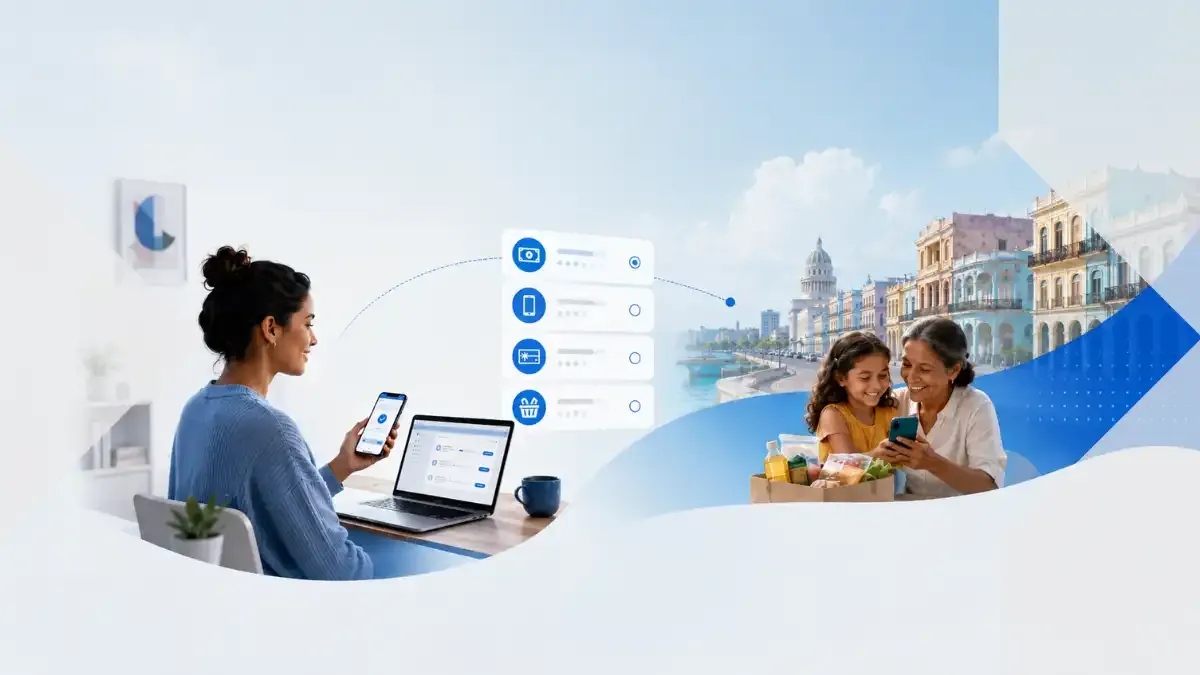
For millions of Cuban families, distance does not mean disconnection. Relatives living abroad continue to provide support in many forms, from money for everyday expenses to mobile connectivity, digital products, food, and other practical necessities. In 2026, that connection remains especially important as households navigate continued economic pressure and an increasingly complex environment for receiving support from abroad.
The ways families can send that support have also become more diverse. Different providers may offer different currencies, exchange rates, fees, delivery methods, and conditions, while the practical value of each option can depend on what the recipient actually needs. This makes transparency increasingly important for anyone evaluating remittances to Cuba or other ways of helping relatives and friends on the island.
A recently launched tool from Cuban media organization elTOQUE reflects that growing need for clearer information. Its Compara remesas a Cuba tool allows users to examine different remittance services and transfer conditions from one place instead of navigating every option separately. The tool adds a new layer of visibility to a market in which understanding the details of a transfer can be just as important as choosing a provider.
Reliable statistics on the total value of remittances to Cuba are unusually difficult to establish. Unlike many other countries, Cuba does not publish comprehensive official remittance figures that allow for consistent measurement of current inflows, and estimates from external organizations can differ significantly. For that reason, any precise claim about the total amount entering Cuba through remittances should be treated carefully.
What is much clearer is the importance of support from abroad at the household level. Reuters reported in 2024, citing a 2023 report from the United Nations Economic Commission for Latin America and the Caribbean, that almost 70% of Cuba's population received remittances in varying forms. The same report also highlighted the absence of comprehensive official Cuban government statistics on remittance inflows.
The importance of family support becomes even easier to understand when viewed alongside Cuba's current economic conditions. The World Food Programme's Cuba Country Strategic Plan for 2026 to 2030 describes an economy affected by high inflation and eroded purchasing power, with these pressures reducing households' economic access to adequate and diverse food. Such conditions help explain why financial assistance and other forms of support from relatives abroad can play a significant role in everyday household decisions.
Remittances should therefore not be understood only as financial transactions moving from one country to another. For many families, they are part of a much broader relationship between people who may live thousands of kilometers apart but remain closely connected economically and socially. That relationship can involve money, communication, food, digital products, or other forms of practical assistance depending on what relatives in Cuba need at a particular moment.
The United States remains the largest and most visible center of the Cuban diaspora. According to a May 2026 analysis by Pew Research Center, approximately 2.9 million people of Cuban origin lived in the United States in 2024, including around 1.67 million immigrants. Those figures illustrate the scale of the family and community connections that continue to link Cuba with the United States.
The international Cuban community, however, extends far beyond the United States. Spain's National Statistics Institute reported 252,290 residents born in Cuba as of January 1, 2025, while Cuban communities are also established throughout Latin America, Canada, and other parts of Europe. Migration routes have continued to evolve, creating family networks that span an increasingly broad range of countries and regions.
This geographic diversity matters when discussing money transfers to Cuba. A sender living in Spain may face different currency combinations, payment methods, and provider availability than someone living in the United States, Canada, or elsewhere. The result is a remittance environment in which the right option can depend not only on the recipient in Cuba but also on where the sender lives and how they intend to fund the transfer.
When comparing a remittance service, it can be tempting to focus immediately on the advertised fee. That number matters, but it does not tell the whole story because the total cost of sending money can also depend on the exchange rate and other conditions attached to the transaction. A service with a lower headline fee does not automatically guarantee that the recipient will receive the highest final value.
The World Bank's Remittance Prices Worldwide methodology treats the cost of a remittance as more than a simple transaction charge. Its methodology takes into account both the transfer fee and the exchange-rate margin, while also recognizing factors such as transfer speed and product characteristics when comparing services. This provides a useful framework for understanding why consumers should look at the entire transaction rather than one isolated price.
Imagine two providers that both allow a sender to transfer the equivalent of 100 euros. One may advertise a lower transfer fee but use a less favorable exchange rate, while another may charge slightly more while delivering a larger amount to the recipient. The most useful comparison therefore considers how much arrives, in which currency, under what conditions, and through which delivery method.
Cuba's monetary environment adds another layer of complexity to these decisions. It would be inaccurate to describe the country today as an economy that simply uses either the Cuban peso or the U.S. dollar, because several currencies, payment mechanisms, and exchange arrangements coexist under different conditions. Foreign currency has gained importance in certain areas of the economy even while the Cuban peso remains the national currency.
At the end of 2025, Cuba introduced changes to its foreign-exchange framework involving several exchange-market segments. The structure includes different official rates as well as a floating component, reflecting an attempt to manage a system in which multiple exchange conditions already existed. These changes also mean that statements about the value or role of a particular currency in Cuba need to be carefully qualified rather than simplified.
Access to foreign currency has continued evolving during 2026. In April, Fincimex announced that certain eligible remittances could be received as U.S. dollar cash through Cadeca, with recipients also able to place some or all of those funds on a Clásica card. The development demonstrates how the currency in which money is sent, received, and ultimately accessed can be an important practical consideration for Cuban recipients.
International payment infrastructure can also change suddenly. In June 2026, Cuba announced the suspension of Visa and Mastercard transactions processed through an affected arrangement after a foreign partner restricted operations amid the new U.S. sanctions environment. Events like this illustrate why senders should confirm current service availability and delivery conditions rather than assuming that a payment mechanism available in the past will necessarily remain unchanged.
International remittances to Cuba also operate within a regulatory environment that can change over time. In May 2026, the United States introduced Executive Order 14404, creating an additional Cuba-related sanctions framework that increased potential sanctions exposure for certain foreign persons, entities, financial institutions, and activities connected with Cuba. The change added another consideration for companies and financial intermediaries operating in or around Cuba-related payment channels.
The new sanctions framework should not, however, be interpreted as a blanket prohibition on sending remittances to Cuba. The U.S. Treasury Department's Office of Foreign Assets Control clarified that existing prohibitions and authorizations under the Cuban Assets Control Regulations remained in effect, and it issued General License 1 to address transactions already authorized or exempt under those regulations. The legal framework therefore continues to distinguish between authorized transactions and activities that remain prohibited or restricted.
For consumers, there is also an important distinction between whether a transaction is legally authorized and whether a particular bank, payment processor, or remittance provider is operationally able to process it. Institutions may make their own decisions based on compliance requirements, partnerships, sanctions risk, and available payment infrastructure. This is another reason why current, clearly presented information can be valuable when someone is deciding how to support a recipient in Cuba.
The evolution of the remittance market gives families more ways to transfer support, but more choice can also make decisions harder. A sender may need to compare several providers across multiple websites, with each service presenting currencies, fees, exchange rates, and delivery conditions in a different way. Availability can also vary depending on the sending country, amount, funding currency, or way in which the recipient wants to receive the money.
This is where comparison tools can become especially useful. A well-designed remittance comparator does not need to tell consumers that one company is universally better than every other option, because the best choice can depend on the circumstances of each transaction. Its value comes from organizing information so users can examine available services and make their own decisions based on cost, convenience, delivery method, recipient needs, and other relevant factors.
The World Bank has long recognized the importance of transparency in remittance pricing through its Remittance Prices Worldwide initiative. Clearer information can help consumers make better-informed choices while also encouraging providers to compete on price and service quality. In a market as operationally complex as Cuba, that principle has particular relevance.
In July 2026, elTOQUE introduced Compara remesas a Cuba, a free online comparison tool designed to help members of the Cuban diaspora examine different ways to send money to the island. The service brings information from available providers into a single comparison environment, making it easier to understand how different transfer configurations may work. Its launch reflects the increasing need for practical information in a market where transfer conditions can differ substantially.
The process begins with a set of straightforward search fields. Users select the country they are sending from, the sending currency, the transfer amount, the currency the recipient should receive, and, if desired, a particular delivery method. The tool then presents available remittance options together with information such as the amount reaching the recipient and the commission associated with the service.
This type of interface addresses one of the main challenges of remittance comparison. Instead of visiting multiple provider websites before understanding which services may be available for a particular transaction, users can begin with a common set of parameters and see relevant options together. They should still confirm the final rate, fee, availability, and terms with the provider before completing a transaction because remittance conditions can change.
elTOQUE also makes an important distinction regarding the information displayed. The comparator states that the information is provided for reference and that elTOQUE does not recommend providers. That distinction is important because appearing in the tool should be understood as visibility within a comparison environment, not as an endorsement or certification by elTOQUE.
Comparison services have become familiar in many areas of everyday life, from travel and insurance to banking and telecommunications. Their usefulness comes from reducing the effort required to understand different offers and presenting key variables in a format that makes alternatives easier to evaluate. Remittances can benefit from the same principle because the cost and usefulness of a transfer depend on several interconnected conditions.
The relevance is especially clear when sending money to Cuba. One person may prioritize the final amount received, while another may need home delivery because that is more convenient for the recipient. Another sender may care most about receiving currency, transaction speed, or whether the service is available from the country in which they live.
A comparator can make these variables easier to see without deciding on behalf of the user. Instead of asking only how much a transfer costs, the sender can consider which combination of cost, currency, availability, and delivery method works best for the person receiving the support. That shift from a single price comparison to a broader value comparison is one of the most useful aspects of tools such as elTOQUE Remesas.
The new elTOQUE environment also provides another place where users can encounter services already offering money transfers to Cuba, including sendvalu, when the selected country, currency, and transaction conditions are supported. The relevance of that presence is not about occupying a particular position in a ranking or suggesting that one provider will always be the best choice. It gives potential users another way to discover the service while comparing the different options available for their particular transfer.
For Cuba, the current sendvalu service information lists several ways recipients can receive money, including home delivery, debit card, and prepaid card options. Certain supported MLC cards from Banco Metropolitano, BANDEC, and BPA are also documented for applicable transfers, subject to the recipient's card being active and enabled for international transactions. The availability of different receiving mechanisms gives senders an opportunity to choose according to the recipient's circumstances rather than relying on one universal payout method.
Home delivery can be particularly useful for recipients who value receiving funds directly at their address. According to the current service information, local partners coordinate the delivery with the recipient and arrange timing based on availability. Card-based alternatives can serve recipients whose circumstances make those mechanisms more practical, but senders should always check the exact conditions shown for their individual transaction.
Price and convenience are important when evaluating a transfer, but consumers are also sharing personal information and payment details. Security should therefore be considered alongside fees, exchange rates, speed, and delivery methods. Trust is most useful when it is supported by specific practices rather than general marketing language.
Current sendvalu documentation describes several security measures used by the platform. These include SSL-secured connections when users enter information, PCI-related standards for card transactions, non-storage of card numbers, secure handling of customer information, and 3D Secure mechanisms for applicable card payments. Such measures provide concrete information that users can consider when assessing whether they are comfortable completing an online financial transaction.
Security still depends partly on the behavior of the user. Senders should protect their passwords, verify recipient details carefully, confirm that they are using the legitimate website or application, and avoid responding to suspicious requests for account or payment information. These basic precautions remain important regardless of which remittance provider someone chooses.
Family support does not always need to take the form of a traditional money transfer. Different circumstances may call for different solutions, which is why the current sendvalu offering for Cuba also includes mobile top-ups, digital gift cards, and food baskets. Together with money transfers, these services provide several ways for people abroad to respond to different everyday needs.
Mobile Top-Ups for Staying Connected
Communication can be one of the most immediate needs for families living in different countries. Mobile top-ups allow a sender to recharge a Cuban mobile number remotely, helping relatives maintain access to calls, messaging, and mobile internet depending on the applicable Cubacel service conditions. The current sendvalu Cuba service includes dedicated mobile recharge options for this purpose.
A mobile top-up serves a different purpose from a remittance because the value is directed specifically toward telecommunications rather than general spending. This can make it useful when staying in contact is the immediate priority. It also illustrates how international family support can include practical digital services in addition to financial transfers.
Digital Gift Cards for Targeted Support
Digital gift cards provide another way to support someone without sending unrestricted cash. The current sendvalu Cuba offering includes digital gift-card options that allow senders to purchase specific digital value or products for recipients depending on the available card. This creates another form of targeted assistance that can complement a traditional remittance.
The usefulness of a gift card depends on what the recipient needs and where the card can be used. A sender should therefore check the product details, redemption conditions, and availability before purchasing one. When those conditions match the recipient's needs, digital gift cards can provide a convenient alternative for delivering a specific type of value.
Food Baskets for Direct Household Support
Food baskets offer a more direct form of material assistance. Current sendvalu information indicates that food combos are available in Havana, Villa Clara, and Cienfuegos, with the service currently offered through the mobile app during its initial stage. The available baskets contain combinations of food products depending on the selected option and current availability.
This service differs significantly from a remittance because the sender is not transferring funds for the recipient to allocate independently. Instead, support is converted directly into food products and delivered within the areas currently covered by the service. That can be useful when the sender wants to address a specific household need rather than provide general financial support.
Money transfers, mobile top-ups, digital gift cards, and food baskets therefore serve different purposes. A money transfer provides flexibility, a top-up supports communication, a gift card directs value toward a particular use, and a food basket provides tangible household products. The most appropriate option depends on what the recipient needs at the time and which services are currently available in their location.
Choosing a remittance service should begin with the amount the recipient will ultimately receive rather than the fee displayed in isolation. The transfer fee, exchange rate, and receiving currency can all influence the practical value of the transaction. Comparing these elements together provides a more realistic picture of what the transfer will deliver.
Delivery method should also be considered carefully. Home delivery, card-based receipt, and other available mechanisms may offer different levels of convenience depending on the recipient's location, mobility, financial access, and preferences. A method that works well for one family may be inconvenient for another.
Speed can matter, particularly when support is needed urgently. Transfer times may depend on verification, the sender's payment method, provider processing, local partners, and other operational conditions. For that reason, users should check the expected timing shown for their specific transaction instead of assuming that every transfer follows the same schedule.
Current availability is equally important in the Cuban context. Regulatory requirements, payment infrastructure, partner relationships, currency arrangements, and operational conditions can change, sometimes quickly. Confirming that the selected corridor and delivery method are still available immediately before sending can help avoid unnecessary complications.
Security should remain part of the decision as well. Users should look for documented security practices, use established platforms, verify website addresses, protect account credentials, and review recipient information before confirming a transaction. A complete comparison therefore considers value, convenience, reliability, and security together rather than reducing the decision to price alone.
The ways families support loved ones in Cuba continue to evolve. Remittances remain an important part of that connection, but the broader environment now encompasses diverse providers, currencies, delivery mechanisms, digital services, and evolving regulatory conditions. Greater choice can be valuable, but it also makes access to clear and current information increasingly important.
The launch of elTOQUE's Remesas para Cuba comparator is relevant because it gives users another way to organize that information and examine available remittance services before deciding how to send. Its role is not to choose a provider on behalf of the user or guarantee that one service will always offer the best conditions. Instead, it can help make the variables behind a transfer easier to understand.
Among the options users may encounter when researching supported transfers is sendvalu, which provides different money-delivery possibilities for Cuba alongside mobile top-ups, digital gift cards, and food baskets in currently supported areas. These services address different forms of family support, from financial flexibility and communication to targeted digital value and direct household assistance. For families separated by distance, having several ways to respond to what loved ones actually need can make international support more practical and meaningful.
Sources:
Reuters – Western Union Resumes Remittance Service to Cuba After 3-Month Outage
World Food Programme – Cuba Country Strategic Plan (2026–2030)
World Bank – Remittance Prices Worldwide: Methodology
Pew Research Center – 10 Facts About Cubans in the U.S.
International Organization for Migration – Cuban Migration Dynamics in Latin America and the Caribbean (January–May 2026)
The White House – Executive Order 14404
elTOQUE – Compara remesas a Cuba
Customer reviews
Why do they trust us? Read what our customers say about sendvalu.


Rated Best Over 5174 Reviews
